


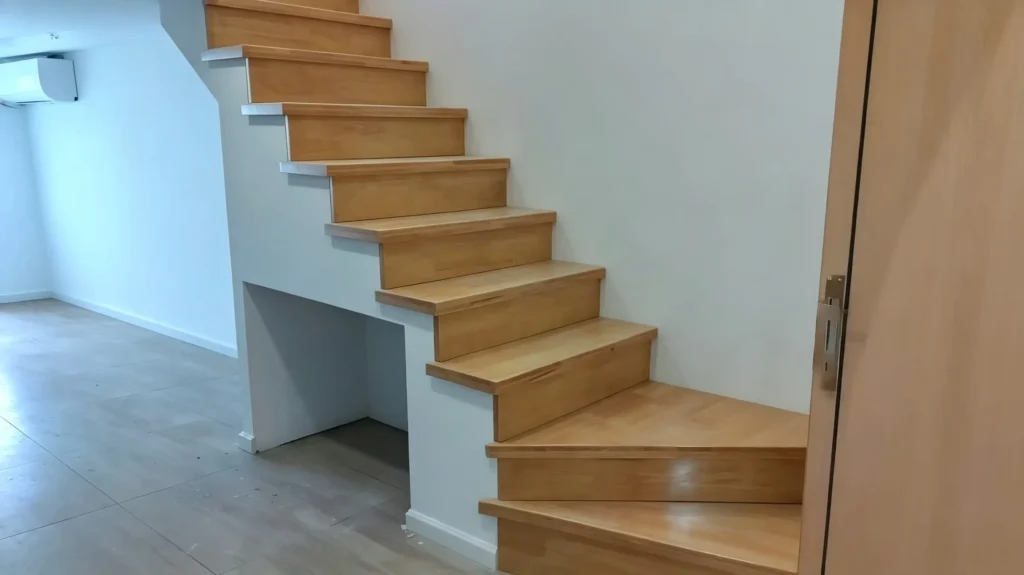

However, a proper stair treads production process requires precise control of material properties (MC < 8%), dimensional tolerances (±0.3mm), and surface finish quality (Ra ≤ 1.6µm). This technical guide covers every step of the wooden stairs treads production process, from lumber selection to final installation support, with engineering rigor and practical shop-floor experience.”
From Product Supplier to Problem-Solving Partner
At Meizstairs, we have evolved from a simple supplier of wooden stairs treads to a comprehensive problem-solving partner. This guide reflects our 15 years of experience in the product production process—sharing not just what we make, but how we make it and why every step matters.
Whether you are an architect specifying wooden stairs treads for a commercial project, a contractor installing prefinished oak stair treads, or a homeowner planning a custom staircase, this guide provides the technical knowledge you need to make informed decisions throughout the your treads production process. In short, every stakeholder benefits from understanding the process.
Why Manufacturing Quality Matters for Wooden Stairs Treads
Quality in the wooden stairs treads production process is not optional—it is structural. A poorly manufactured tread can fail under load, creating safety hazards and costly repairs. Conversely, a properly manufactured wooden stairs tread provides decades of reliable service. Key quality indicators include:
- Structural Integrity – Proper grain orientation and defect-free load-bearing zones
- Dimensional Stability – Correct moisture content to prevent warping or shrinking
- Surface Durability – Proper finish selection and application for wear resistance
- Aesthetic Consistency – Color matching and grain continuity across all treads
- Installation Readiness – Precise dimensions and edge profiles for seamless fitting
For the components production process, quality is built in at every stage—not inspected in at the end. That is to say, each step must be executed correctly from the start.
Step 1: Lumber Selection for
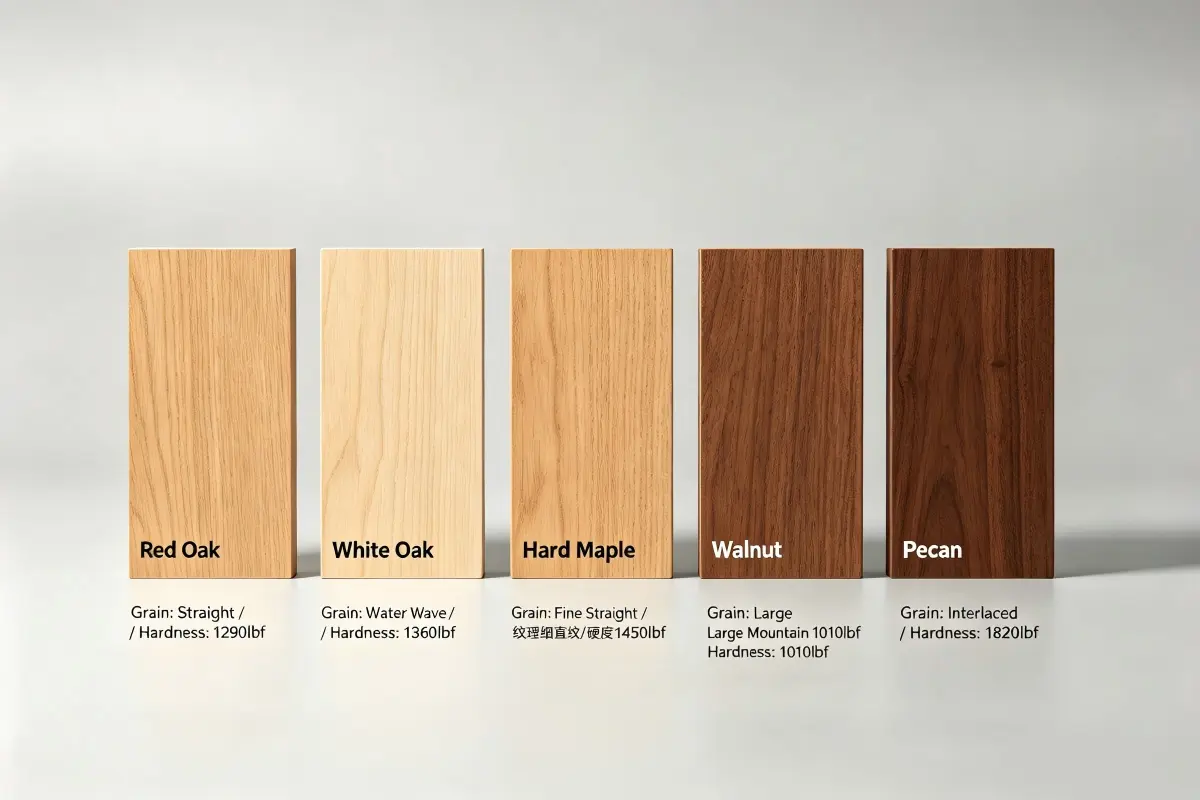
The these parts production process begins with selecting the right lumber. For example, wood species commonly used for wooden stairs treads include:
| Species | Janka Hardness (lbf) | Density (g/cm³) | MOR (psi) | MOE (10⁶ psi) | Stability |
|---|---|---|---|---|---|
| White Oak | 1,360 | 0.75 | 14,300 | 1.72 | Excellent |
| Hard Maple | 1,450 | 0.71 | 15,800 | 1.83 | Excellent |
| Red Oak | 1,290 | 0.69 | 13,700 | 1.68 | Good |
| Black Walnut | 1,010 | 0.60 | 11,200 | 1.52 | Good |
| Cherry | 950 | 0.58 | 10,900 | 1.48 | Moderate |
| Ash | 1,320 | 0.67 | 13,400 | 1.63 | Good |
Grading Standards for Wooden Stairs
For the workpieces production process, lumber must meet specific grade requirements:
- FAS (First and Second) – Highest grade, minimal defects, ideal for premium wooden stairs treads
- Select – Good quality, minor defects acceptable for painted these items
- #1 Common – Economy grade, suitable for utility or painted applications
For the wooden stairs treads production process, FAS grade is recommended for clear, natural finishes. Meanwhile, Select grade is acceptable for painted or darker stained the stock where minor defects are less visible.
Step 2: Kiln Drying Wooden Stairs Treads
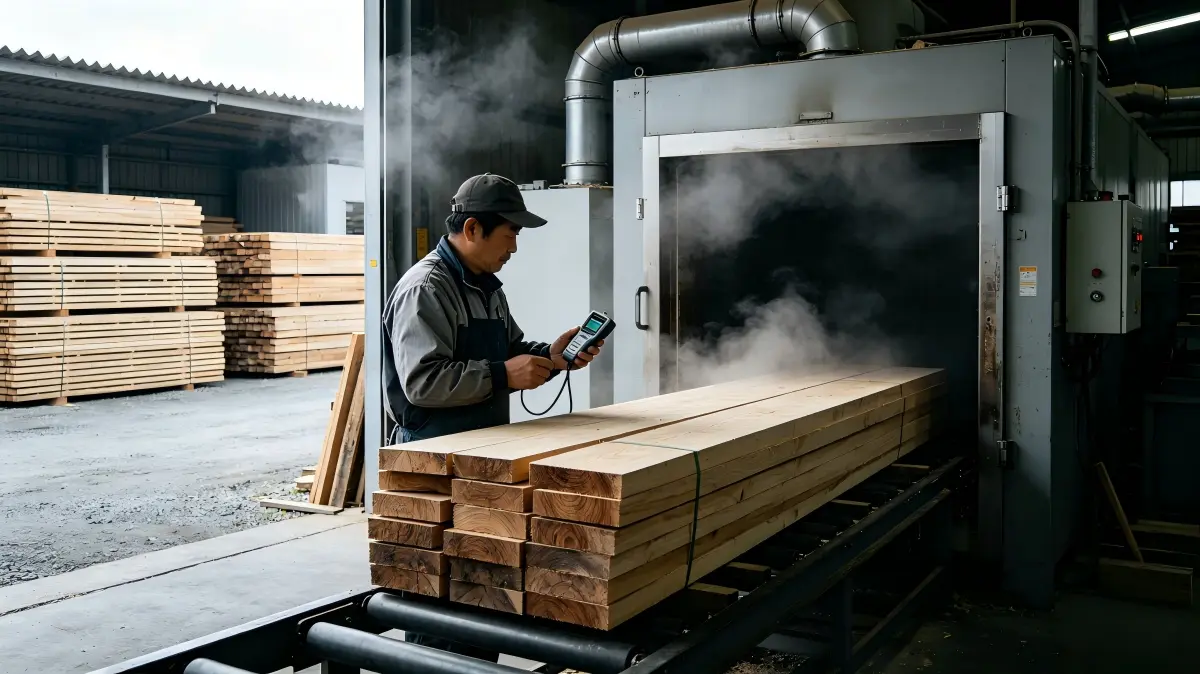
Moisture content (MC) is the most critical variable in the the product production process. Improper moisture control leads to warping, cupping, splitting, and joint failure.
| Stage | MC Range | Duration | Purpose |
|---|---|---|---|
| Green | 30–60% | As received | Initial moisture after sawmilling |
| Air Drying | 15–20% | 30–90 days | Initial moisture reduction |
| Kiln Drying | 6–8% | 7–14 days | Final moisture control for wooden stairs treads |
| Conditioning | 6–8% | 48–72 hours | Stress equalization in wooden stairs treads |
Drying schedule parameters:
- Temperature: Gradual ramp from 100°F to 160°F (38°C to 71°C) depending on species
- Relative Humidity: Controlled from 80% down to 30% during the drying cycle
- Airflow: Minimum 300 ft/min across the lumber stack
- Final MC verification: Every batch verified with a pin-type moisture meter per ASTM D4442
Step 3: Rough Milling & Defect Removal
In the wooden stairs treads production process, rough milling transforms kiln-dried lumber into dimensionally accurate blanks ready for further processing.
| Operation | Equipment | Target Tolerance | Purpose |
|---|---|---|---|
| Flattening | Jointer (8″ capacity) | ±0.5mm | Create flat reference surface |
| Thicknessing | Planer (13″ capacity) | ±0.3mm | Consistent thickness |
| Edge Jointing | Jointer or table saw | ±0.2mm | Square edges for glue-up |
| Defect Removal | Table saw / Band saw | N/A | Cut out knots, cracks, or voids |
Defect removal criteria for the wooden stairs treads production process:
- Knots: Remove knots > 15mm diameter in load-bearing zones
- Checks: Remove surface checks > 0.5mm width
- Splits: Remove splits extending > 10% of length
- Wane: Remove bark-edge material
Step 4: Glue-Up & Panel Lamination (For Wide Treads)
For wooden stairs treads wider than available lumber (typically > 8–10 inches), panel lamination is required in the units production process.
| Adhesive Type | Open Time | Clamp Pressure | Cure Time | Water Resistance |
|---|---|---|---|---|
| PVA (Yellow) | 5–10 min | 10–15 psi | 24 hours | Moderate |
| EPI (Emulsion Polymer) | 10–15 min | 10–15 psi | 24 hours | Good |
| PU (Polyurethane) | 15–20 min | 10–15 psi | 24–48 hours | Excellent |
Lamination process steps for the wooden stairs treads production process:
- Edge preparation – Joint edges square and smooth for tight glue joints
- Grain matching – Arrange boards for optimal grain continuity in wooden stairs treads
- Adhesive application – Apply structural wood adhesive (Type I or II per ASTM D3110)
- Clamping – Apply 10–15 psi pressure for 60–90 minutes
- Curing – Allow 24 hours minimum before further processing
- Surface leveling – Sand or plane to final thickness
Step 5: CNC Precision Profiling
Our 5-axis CNC machines cut precise profiles for the wooden stairs treads production process. Furthermore, CNC technology ensures consistent profiles across all treads with tight tolerances.
| Profile Type | Radius | Tolerance | Application |
|---|---|---|---|
| Bullnose | 6–12 mm | ±0.5mm | High-traffic, safety-critical |
| Eased Edge | 1.5–3 mm | ±0.3mm | Residential, modern |
| Square Edge | 0.5–1 mm | ±0.2mm | Contemporary, minimalist |
| Ogee | Composite | ±0.5mm | Traditional, decorative |
| Double Bullnose | 6–12 mm both edges | ±0.5mm | Open-sided stairs |
Step 6: Sanding Wooden Stairs Treads to Perfection
.webp)
Multi-stage sanding is essential in the your treadsproduction process to achieve the surface quality required for premium finishes.
| Stage | Grit | Target Ra (μm) | Purpose |
|---|---|---|---|
| Primary | 80 | ≤ 6.3 | Remove machining marks |
| Secondary | 120 | ≤ 3.2 | Initial smoothing |
| Fine | 180 | ≤ 1.6 | Pre-finish preparation |
| Final | 220 | ≤ 0.8 | Finish-ready surface |
Sanding parameters for the wooden stairs treads production process:
- Pressure: 2–3 N/cm² (excessive pressure causes burn marks)
- Feed direction: Always sand with the grain
- Between grits: Vacuum dust thoroughly to prevent cross-scratching
Step 7: Finishing Wooden Stairs Treads
For prefinished oak stair treads and prefinished wooden stairs treads, finish application is a controlled process in the these products production process.
| Finish Type | Film Thickness | Taber Wear | Application | Best Use |
|---|---|---|---|---|
| Conversion Varnish | 75–125 μm | ≤ 30 mg | Spray (HVLP) | Commercial, high-traffic |
| Oil-Based Polyurethane | 100–150 μm | ≤ 45 mg | Brush/Spray | Residential, classic |
| Water-Based Polyurethane | 80–120 μm | ≤ 55 mg | Brush/Spray/Roller | Residential, low odor |
| Hard Wax Oil | 30–50 μm | ≤ 70 mg | Hand wipe | Natural, matte finish |
Application conditions for the wooden stairs treads production process:
- Temperature: 20–25°C
- Relative humidity: 40–50%
- Airflow: 0.5–1.0 m/s
- Number of coats: 2–3 (depending on finish type)
- Between coats: Light sanding with 320-grit, dust removal
Step 8: Quality Control & Inspection
Quality control in the wooden stairs treads production process uses systematic inspection at defined control points.
| Inspection Point | Parameter | Acceptance Criteria | Method |
|---|---|---|---|
| Raw Material | MC | 6–8% | Pin meter (ASTM D4442) |
| After Milling | Thickness | ±0.3mm | Digital caliper |
| After Profiling | Profile radius | ±0.5mm | Profile gauge |
| After Sanding | Surface roughness | Ra ≤ 0.8 μm | Profilometer |
| After Finishing | Film thickness | 75–150 μm | Coating thickness gauge |
| Final | Dimension | Per shop drawing | Full measurement |
Common Mistakes to Avoid
| Mistake | Consequence | How to Avoid |
|---|---|---|
| Not verifying MC | Warping, gapping after installation | Request MC data from supplier |
| Choosing the wrong finish | Premature wear, staining | Match finish to traffic level |
| Skipping acclimation | Cupping, buckling | Acclimate treads 48–72 hours on-site |
| Not ordering extra | Color mismatch on replacements | Order 10–15% overage |
Technical Summary: The wooden stairs treads production process requires systematic control across all manufacturing stages. First, select quality lumber meeting grade and hardness specifications. Next, kiln-dry to 6–8% MC for dimensional stability. Then, mill accurately to ±0.3mm tolerances. Furthermore, laminate wide treads with proper adhesive and clamping. Additionally, CNC-profile consistent edge treatments. Moreover, multi-stage sanding achieves Ra ≤ 0.8 μm surface quality. Subsequently, apply finish under controlled conditions. Finally, perform systematic quality control at every stage. Therefore, a rigorous stair treads production process delivers products that meet or exceed all performance, safety, and aesthetic requirements for residential and commercial stair applications.
Ready to Order Professional Wood Stair Treads?
Contact Meizstairs today. We will help you design, engineer, and fabricate custom wooden stairs treads to exact specifications. Our expert team is ready to assist with technical guidance, material recommendations, and production planning.


